
Data Center Consolidation support for a Fortune 200 Financial Services Firm
Enabling the Centralization of ~95% of Enterprise IT Through Scalable Delivery Support
Talent Delivered
- Project Managers
- Architects
- Unix and Linux Engineers
- Network / Migration Engineers
- Database Administrators
Quick Facts:
Engagement Model: SOW-based consulting and delivery support
Program Duration: 18 months
Global Scope: Worldwide data centers and server rooms
Target State:
- 30 major data centers consolidated
- 2 primary US data centers
- ~95 percent of IT presence centralized
More Statement of Work Case Studies
Date: February 25, 2026
Supported a structured migration methodology, with specialized resources assigned to defined tasks.
OVERVIEW
Client Overview:
A Fortune 200 Financial Services firm launched a global data center consolidation initiative spanning all data centers and server rooms worldwide. The objective was to migrate the 30 largest data centers into two primary US-based facilities, centralizing approximately 95 percent of the company’s IT footprint.
The program was led by a global Systems Integrator with end-to-end ownership of delivery and outcomes. Our engagement was structured as a consulting-led SOW, providing specialized infrastructure and migration delivery support embedded within established governance frameworks.
Program Overview:
A Migration Team was put in place which essentially compartmentalized functions in order to perform multiple migrations concurrently. The Migration Team was made up of three different groups:
- Site Governance and Project Leadership Teams
- The Migration Team covering discovery, network, testing, and execution
- The Release and Build Team
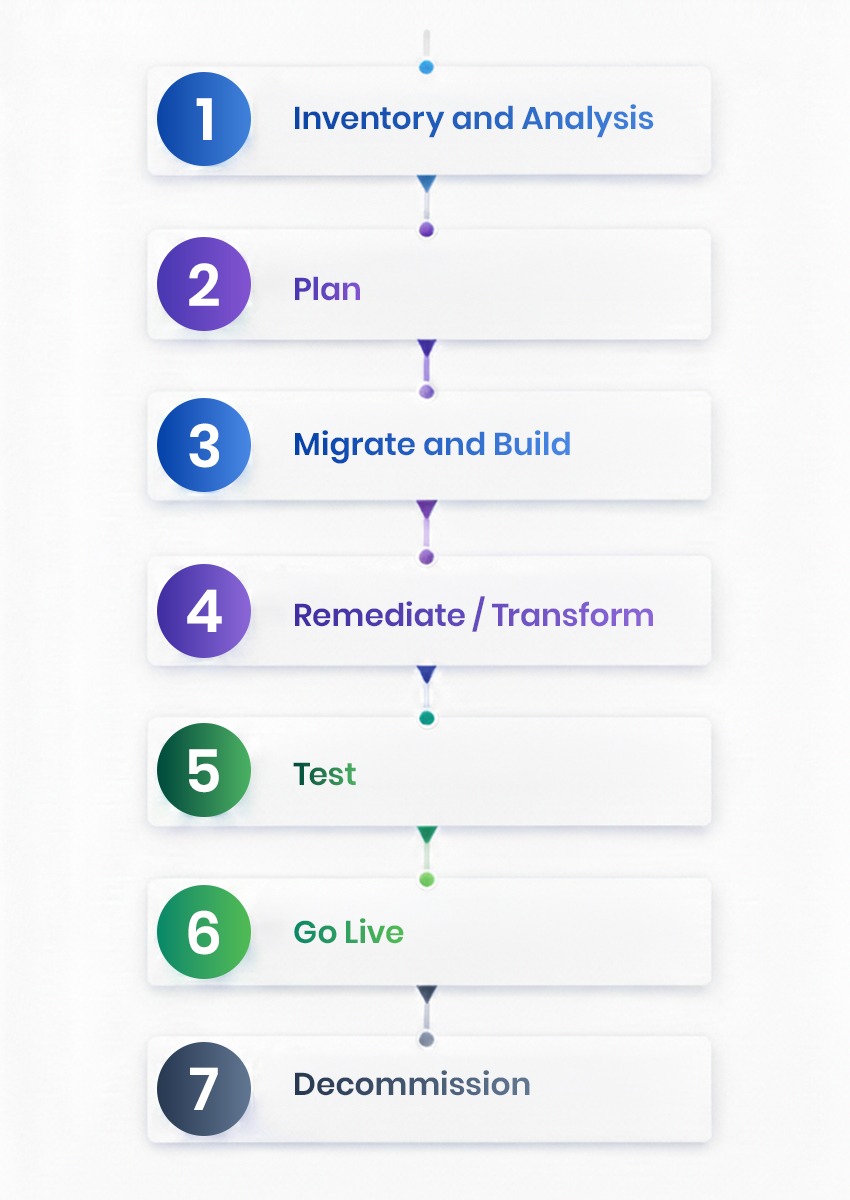
Migration Approach: In order to manage the high volumes of application migrating each quarter (~2,000), a stringent set of principles and standards were put in place to minimize the decision process on what to do with each application. The Migration Approach is quite straightforward:
Our Engagement Scope
We supported the Systems Integrator across multiple concurrent migration workstreams, providing consulting-led infrastructure delivery support. Our teams operated within established governance frameworks, migration methodologies, and program schedules, enabling coordinated execution at scale while minimizing operational disruption.
Services Delivered included:
- Data center consolidation support
- Infrastructure, Application, Financial, War Room, and Site Project Management
- Solution Architecture
- Unix and Linux Engineering
- Migration Engineering
- Network Engineering
- Oracle Database Administration
Talent Delivered
- Total Resources Deployed: 27
- Capabilities Covered:
- Project Managers across infrastructure, applications, finance, war room, and site operations
- Solution Architects
- Unix and Linux Engineers
- Migration Engineers
- Network Engineers
- Oracle DBAs
The rapid deployment of specialized resources enabled parallel migrations across multiple global locations while maintaining alignment with program timelines and delivery standards.
Key Challenges
- The scale and pace of the program required continuous pipeline development to support fluctuating demand.
- Specialized resources needed to be identified, vetted, and kept deployment-ready to meet aggressive migration schedules across geographies.
Our Approach
- Proactive Sourcing: We anticipated demand early and built a deployment-ready talent pool aligned to project requirements, skills, and timelines.
- Continuously Engaged Candidate Pipeline: We maintained active engagement with shortlisted candidates to ensure readiness, availability, and rapid mobilization as program needs evolved.
- Innovative Candidate Engagement: We applied targeted outreach, transparent role positioning, and compelling value propositions to attract and secure top-tier talent in a highly competitive market.
Results
- Supported a global, multi-site data center consolidation initiative
- Delivered 27 specialized resources aligned to program governance and execution standards
- Enabled parallel migration execution across regions, contributing to the consolidation of 30 major data centers into two primary facilities and the centralization of approximately 95 percent of the client’s IT footprint.